
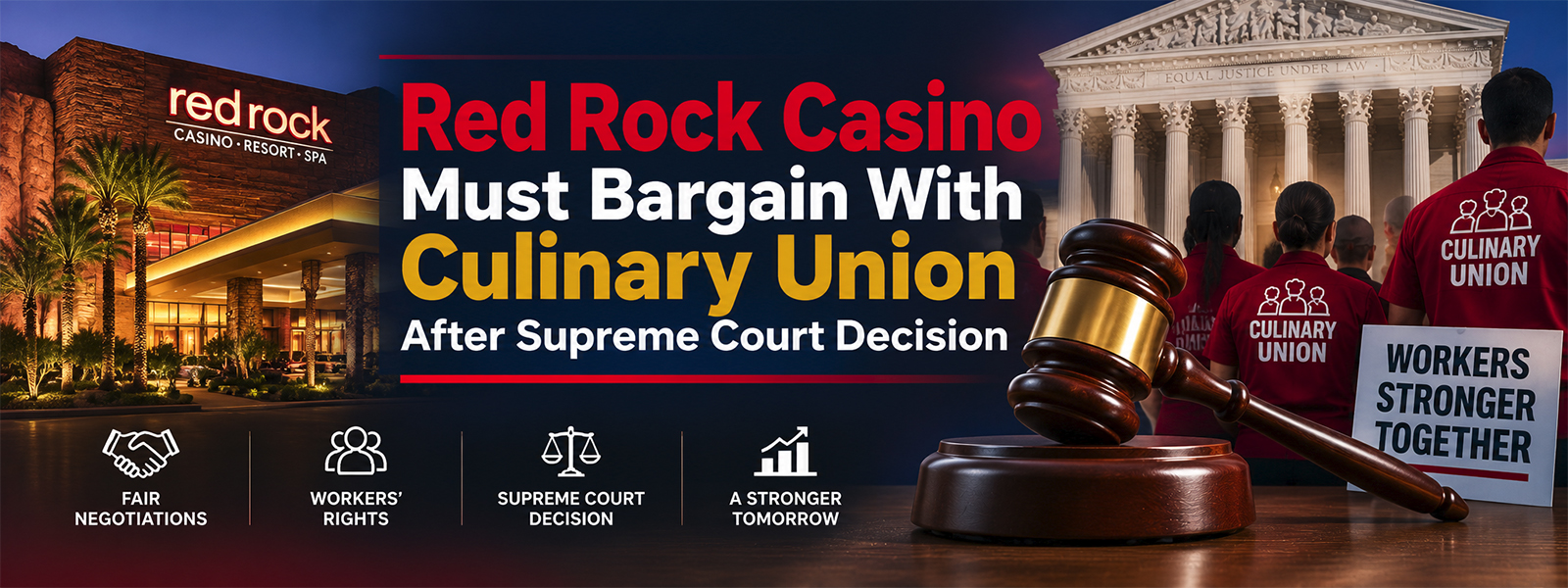
A long-running labor dispute involving Red Rock Casino Resort & Spa in Las Vegas has taken another important turn after the US Supreme Court rejected the casino’s emergency request to pause a federal bargaining order.
Chief Justice John Roberts denied Red Rock’s application on September 4, 2026, leaving in place an earlier ruling requiring the casino to recognize and bargain in good faith with Culinary Union Local 226.
The dispute has roots in Red Rock’s dealings with employees during a previous union-organizing campaign and has been moving through the US legal system for years.
Red Rock had asked the Supreme Court to temporarily block the lower-court decision while it continued seeking further legal review.
That request was denied.
As a result, the lower-court ruling remains in effect, requiring Red Rock to comply with the National Labor Relations Board’s bargaining order. The casino must also post notices informing employees about their rights under federal labor law.
The legal history behind the order is significant.
In an earlier NLRB proceeding, officials found that Red Rock had engaged in serious unfair labor practices during an effort by employees to organize. The NLRB concluded that the conduct was sufficiently serious to justify a bargaining order rather than simply another election.
The Red Rock dispute is not a new issue for Station Casinos.
The NLRB previously found that Red Rock’s conduct during the organizing campaign undermined the possibility of a fair election. In 2022, an administrative law judge ordered the casino to bargain with the union after finding extensive misconduct surrounding the union campaign.
The case subsequently moved through the federal appeals process. The latest development means the legal pressure on Red Rock has increased rather than faded.
For the company, bargaining with the union now becomes a practical obligation while the wider legal dispute continues. For Culinary Union Local 226, the ruling represents an important step in its long-running effort to secure representation for workers at the property.
Labor relations are a major issue across the Las Vegas hospitality and casino industry. Casinos employ thousands of workers across hotel operations, food and beverage, housekeeping, entertainment and gaming-related services. Union contracts can influence wages, healthcare, working conditions, and other employment terms.
Because Red Rock is part of Station Casinos, the dispute also attracts attention beyond the individual property.
The Supreme Court’s decision demonstrates that labor disputes involving major casino operators can develop into lengthy legal battles involving federal agencies and multiple courts.
For other gaming companies, the case may serve as a reminder of the importance of complying with labor laws during union campaigns and employee-organizing drives.
What Happens Next?
The immediate consequence is straightforward: Red Rock must comply with the existing order and bargain with Culinary Union Local 226.
The broader legal battle may continue, but the Supreme Court’s refusal to grant an emergency stay removes an important temporary barrier.
For employees, the decision potentially creates a clearer path toward formal union negotiations. For Red Rock, it creates additional obligations at a property that has been at the center of one of Nevada’s most closely watched casino labor disputes.
As Las Vegas continues to evolve as a global hospitality and entertainment destination, labor relations will remain an important issue. The Red Rock case is likely to remain under the spotlight as both sides navigate what comes next.
Sources: US Supreme Court, National Labor Relations Board, GamblingNews and CDC Gaming. (Supreme Court)